 how-to
Colorado Mountain Home Appraisal Tips for Sellers
Last Updated: October 26, 2026
Quick Summary
A Colorado mountain home appraisal weighs access, terrain, utilities, and hazard exposure as heavily as the house itself, so sellers should prep both the property and a documentation package before the appraiser arrives. Because rural sales data is thin, your mountain home appraisal depends on well logs, septic records, permits, and comps sorted by geography, elevation, access, and sale date.
- Clear snow and ice from the driveway, walkways, and paths to outbuildings before the visit.
- Build one PDF folder with well tests, septic records, permits, utility bills, and a survey.
- Appraisers widen comp searches in a defined order, and each bracket adds adjustment risk.
- A 12- to 18-month-old sale may be the best comp but needs a market-condition adjustment.
- Request a reconsideration of value in writing with corrected facts and better comps.
Table of Contents
- Why a Colorado Mountain Home Appraisal Follows Different Rules
- Your Mountain Home Appraisal Checklist: What to Do Before the Appraiser Arrives
- Appraisal Documents for Rural Homes: The Paper Trail That Supports Value
- How Mountain Property Comparable Sales Are Selected
- Features That Move the Number: Well, Septic, Wildfire, and Winter Access
- Low Home Appraisal Options: What to Do When the Number Falls Short
- Get a Free Home Valuation Before the Appraiser Knocks
- Frequently Asked Questions
Why a Colorado Mountain Home Appraisal Follows Different Rules
A Colorado mountain home appraisal is not a flat-land appraisal with a nicer view. At Purple Mtn Group, we understand that appraisers may spend more time checking access roads and well logs than counting bedrooms.
The reason is simple. Lenders want proof that a buyer's loan is backed by real value. On a mountain property, that proof lives in details flat-land appraisals never touch:
- Whether the driveway is plowed and passable in February
- Whether the well produces enough water year-round
- Whether the roof is rated for heavy snow load
- Whether the home sits in a wildfire-risk zone
Miss any of these, and the appraised value can land well below the agreed price. Sellers worried about mountain-specific value factors can read how to avoid overpaying for mountain property.
Mountain home appraisal work also leans on rural sales data, which is thinner and harder to verify.
Access, Terrain, and the Factors Flat-Land Appraisals Ignore
Start with access. An appraiser has to be able to reach the property, and so does a future buyer. A steep, unpaved road that's fine in July can read as a risk in January.
Here's what carries real weight in mountain valuation:
- Road access: maintained year-round or seasonal only
- Terrain: usable lot area versus steep, unbuildable slope
- Utilities: well and septic versus public water and sewer
- Hazard exposure: wildfire zone, floodplain, avalanche paths
- Winter maintenance: plowing arrangements and snow storage
A common mistake sellers make is assuming a stunning view cancels out a rough access road. It doesn't. Appraisers weigh function first.
Your Mountain Home Appraisal Checklist: What to Do Before the Appraiser Arrives
The best mountain home appraisal checklist does two jobs: it removes visible reasons for a downward adjustment, and it hands the appraiser written proof of features that are easy to undervalue when they can't be verified. Most sellers handle the first job and skip the second, which is exactly where value gets left on the table.
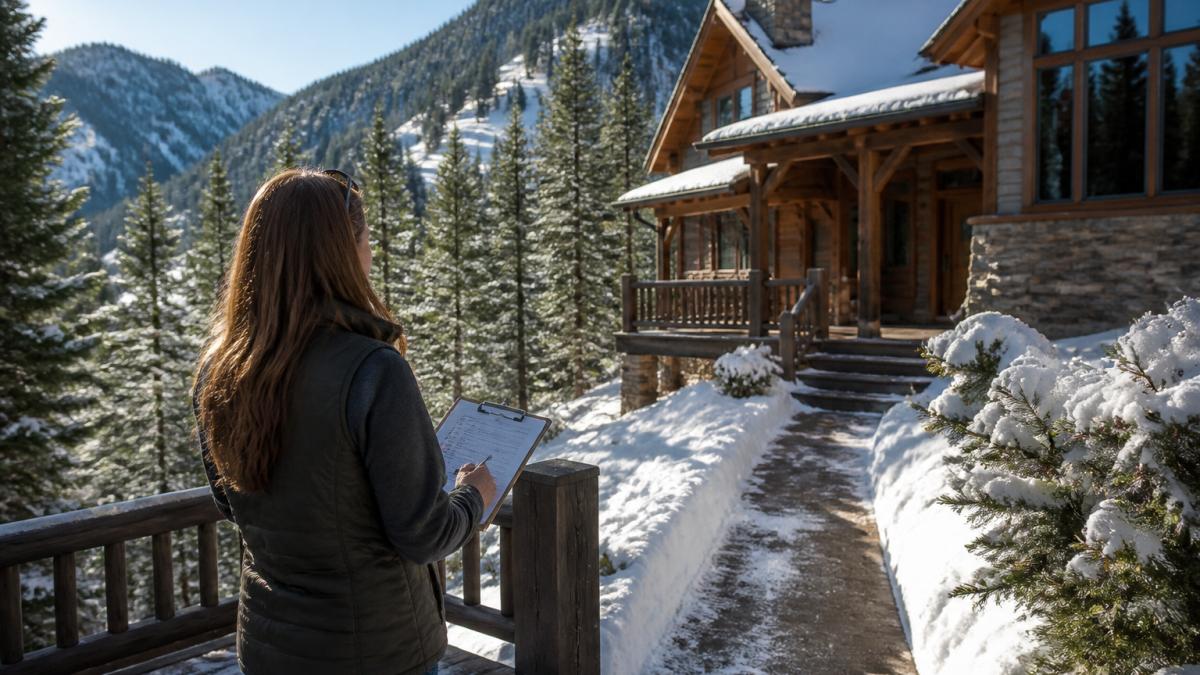
Work through this list in the two weeks before the appointment. The first group is physical prep; the second is the paper trail.
Physical prep
- Repair loose railings, steps, and deck boards, appraisers note safety hazards and deferred maintenance
- Clear snow and ice from the driveway, walkways, and the path to any outbuilding
- Fix obvious leaks, stains, and damaged siding; freeze-thaw cycles accelerate exterior wear at elevation
- Confirm the well pump runs and water pressure holds at fixtures on every floor
- Have the septic tank pumped recently and keep the receipt
- Clear brush and debris away from the exterior, this doubles as defensible-space evidence
- Make sure the appraiser can reach every room, the attic hatch, and the crawlspace
- Leave gate codes, lockbox info, and a phone number where the appraiser can reach you
Documentation prep
- Well test results (flow rate and water quality) and any water-rights paperwork
- Septic inspection, pumping, and design records
- Permits and final inspection sign-offs for additions, decks, outbuildings, and finished basements
- Receipts and dates for major improvements (roof, windows, heating, insulation)
- A survey or plat map showing lot lines, easements, and access
- Utility bills for the past 12 months
- HOA or road-maintenance association documents, including plowing agreements and dues
- A one-page summary of upgrades with dates and costs
Curb Appeal, Minor Repairs, and Decluttering at Altitude
Altitude changes the prep work. Snow, sun, and freeze-thaw cycles wear exteriors faster here, so small issues stand out, a sun-bleached deck or a snow-damaged roof edge reads as neglect even when the structure is sound. Address the visible wear first.
Decluttering matters as much as repairs. Clear counters, open walkways, and tidy rooms help an appraiser judge square footage and condition without distraction. Skip the big renovation; the cost rarely comes back in the appraisal and the appraiser can't credit work that isn't finished.
Appraisal Documents for Rural Homes: The Paper Trail That Supports Value
Appraisal documents for rural homes do more work than most sellers expect. In remote markets, paperwork often decides whether a feature counts as value or gets ignored.
Put together a simple package:
- Well test results and water rights information
- Septic inspection and pumping records
- Utility bills for the past year
- Permits and receipts for improvements
- A survey or plat map
- HOA documents, if any
- A list of recent upgrades with dates
The appraiser can't credit what they can't verify. A well-organized folder turns "unconfirmed" into "documented."
How Mountain Property Comparable Sales Are Selected
Mountain property comparable sales are the closest recent sales an appraiser uses to set value, but in mountain markets 'closest' is doing a lot of heavy lifting. A flat-land appraiser can usually find three or four sales within a mile from the past six months.
Appraisers typically start with a tight bracket and expand in a defined order: same subdivision or road corridor first, then the same elevation band and access type, then a wider radius, then older sale dates. Each expansion introduces adjustment risk, and the report is supposed to explain it.
Finding Comps in Low-Turnover and Remote Markets
Low-turnover markets make comp selection harder because a single sale can swing a valuation. A practical way to think about it is the four brackets an appraiser works through:
- Geography: same subdivision, road, or drainage, not just the same county. A sale across a ridge with a different access road may be a weaker comp than one two miles down the same road.
- Elevation and terrain: a home at 8,500 feet with a steep driveway is not interchangeable with one at 7,000 feet on a flat lot, even at similar square footage.
- Access and utilities: year-round maintained road versus seasonal; well and septic versus public systems. These are the adjustments appraisers make most often and explain least.
- Sale date: in thin markets, appraisers reach back further. A 12- to 18-month-old sale may be the best available comp, but it needs a market-condition adjustment.
If you're selling, ask your agent to pull the comps early and sort them into those same brackets. Knowing which sales an appraiser is likely to weight, and which ones favor your property, protects you from surprises later. If the best comps are older or farther away, gather the context that explains why they still apply: road maintenance records, utility history, and any recent sales activity on your road.
Appraisers widen the search for comps in a defined order, and each bracket adds adjustment risk.
| Bracket | What appraisers look for | Why it matters |
|---|---|---|
| Geography | Same subdivision, road, or drainage | A sale across a ridge may be a weaker comp |
| Elevation and terrain | Same elevation band and terrain type | 8,500 feet with steep driveway is not interchangeable |
| Access and utilities | Year-round road versus seasonal; well and septic versus public | Adjustments made most often and explained least |
| Sale date | Recent sales first, then older dates | A 12- to 18-month-old sale needs a market-condition adjustment |
Features That Move the Number: Well, Septic, Wildfire, and Winter Access
Four features separate mountain homes from flat-land ones, and each one can help or hurt value.
- Well: tested output and water quality matter
- Septic: a documented, working system adds confidence
- Wildfire: defensible space and fire-resistant materials reduce risk
- Winter access: plowed, maintained roads support year-round use
Insurability ties into all four. If an insurer hesitates, a lender may too. Sellers who can show clean records and clear access give appraisers a reason to hold the value up.
Low Home Appraisal Options: What to Do When the Number Falls Short
Low home appraisal options start with reading the report closely. Look for errors: wrong square footage, missed upgrades, or comps that don't match the property.
Your paths forward:
- Request a reconsideration of value. Submit corrected facts and better comps in writing.
- Renegotiate the price. The buyer may meet you partway.
- Cover the gap in cash. The buyer brings the difference to closing.
- Challenge the appraisal through the lender's process.
- Walk away and relist. Sometimes the market, not the report, is the issue.
Act fast. Deadlines in the contract limit how long you have to respond.
Get a Free Home Valuation Before the Appraiser Knocks
The gap between what you think your mountain home is worth and what a lender's appraiser concludes can cost you real money. Close it early. Purple Mtn Group brings 30 years of licensed real estate experience and over $250 million in sales across Denver, Golden, Summit, and Grand County, with a dedicated team that offers deep market insights.
Get a free home valuation with Purple Mtn Group and walk into your appraisal with the right number and the paperwork to back it.
Frequently Asked Questions
How is a mountain home appraised differently from a standard house?
A mountain home appraisal follows the same core process as any residential appraisal, but the appraiser spends far more time on access, terrain, utilities, and winter usability. Expect the inspection to cover the driveway grade, road maintenance agreements, well and septic systems, wildfire exposure, and outbuilding condition. Because sales are sparse, the appraiser also leans on a wider geographic radius and older comparable sales, which is why documentation from the owner matters so much.
What should I give the appraiser as appraisal documents for rural homes?
Put together a package before the visit: building plans and permits, well and septic inspection reports, a survey or plat map, the road maintenance agreement, utility bills, a list of improvements with dates and costs, and any HOA or conservation documents. Photographs of seasonal access, snow removal, and finished work help too. A clear paper trail on features the appraiser cannot see on inspection day is often what separates a supported value from a conservative one.
What can I do if my mountain home appraisal comes in low?
Start by reviewing the report for factual errors: wrong square footage, missed finished space, or comps that are not truly similar. Ask your agent to submit a reconsideration of value with better mountain property comparable sales, photos, and receipts for improvements. If the lender will not budge, you can renegotiate the purchase price, cover the gap in cash, or restructure financing. A low home appraisal options conversation with your agent early keeps the deal from falling apart.
Do well and septic systems affect a mountain home appraisal?
Yes, significantly. A functioning well and septic system supports value, while an untested or failing system can trigger lender conditions or a value adjustment. Have both inspected and keep the reports on hand. If the well produces a low yield or the septic is near the end of its life, disclose it early and get repair estimates, because the appraiser and the buyer's lender will both want to see that information documented.